Sunday, February 11, 2018

From Knowledge to Action

Knowledge isn't power; it's potential power. Execution trumps knowledge any day of the week.
-Tony Robbins
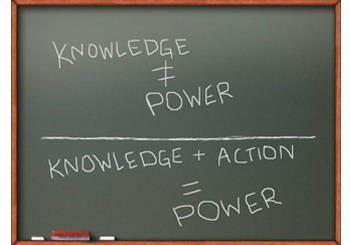

Knowledge is a smoker knowing that smoking cigarettes is very unhealthy.
Execution is a smoker quitting smoking.

The cars of the 1970s and 1980s were constructed a lot differently than the cars of today. Most of these cars were rear wheel drive vehicles, the front tires only being used to direct the car. Due to this setup, drivers were given the following instructions when driving in snow:
Steer into the skid, get your wheels aligned with the direction of the skid, and then turn out of it.

Unfortunately, just because people were taught this, just because this was a piece of knowledge that they knew, doesn't mean that they are able to execute accordingly when the scenario unfolded. Why is that? How could people so easily forget a basic lesson that could be the difference between life and death?

The answer is quite simple. Let’s put ourselves into the driver's seat of this classic car.
We are the driver, we are in control of this car. The car drives when we want it to drive, stops when we want it to stop and it goes in the direction we tell it to go. Now the car goes into a skid. We have lost the control we just had. Feelings of panic kick in. Feelings of helplessness are there too. Add in some anxiety to go along with that sick feeling inside the stomach. The car is skidding left and we need it to go right! Knowledge is telling me to go into the skid, but my intuition is telling me to steer the way I want the car to go!

Knowledge is knowing to steer into the skid, execution is taking the wheel and steering into the skid to regain control. These are two separate things. Obviously one isn't going to properly act without the knowledge, but having the knowledge doesn't mean that one will execute.

There are many reasons for this. One major reason is the failure to internalize the information being learned.
Americans are taught from a very young age to call 911 in an emergency. But how many of us sat and thought about this when we learned it? Teach a child to call 911 in an emergency, then sit there with them and discuss it. Visualize a scenario when they will need to call it. Help the child internalize the lesson, so that they are ready to act and call 911 in an actual emergency. Help them become someone who is able to act, not just someone with knowledge.

The same can be applied to parenting. There are many parents who have the knowledge of what to do, but there are times when they just can’t execute. Let’s illustrate this using sexual abuse as an example:
A child just comes to their parent and reveals that they were abused by someone who the parent knows personally (child in this example can be any age, including an adult). Here is what the parent knows:
· The facts that the child just provided
· Knowledge says that people don’t make up these things
· Knowledge says to speak to the police, and to get help for this child
· Knowledge tells the parent that the child isn't at fault for the abuse
· Knowledge tells the parent that they too might need help coping
But what about the parent’s own emotions? 
Possible emotions include:
· Anger towards the perpetrator
· Anger towards the child (note: while one shouldn't be angry at the victim, this is a perfectly normal feeling in many cases)
· Feelings of letting the child down
· The belief that one isn’t a good parent
· Stubbornness / Refusal to believe that the parent was fooled and/or groomed by the perpetrator
· Fears of possible negative responses from peers and members of the community
· Memories from previous personal traumas 
These personal emotions from the parent can block the execution of the necessary intervention.

This article is being written in response to my previous article “Shifting Gears” . I received some feedback from people who thought that the article didn't really have any useful information to them. That the general principle of the article was something they've known for quite some time, that different times require different types of intervention. My message wasn't clear enough in the previous article. One must know when to switch gears, but one must also be able to execute and actually switch them. Knowing that one needs to do something and actually doing it are not the same thing. Learn about yourself. Learn what stops you from executing the knowledge that you've acquired and learn how to hurdle over these roadblocks that stand between you and a successful execution. Learning how and when to properly execute is an important skill that can be applied to all areas of one’s life.

Yisroel Picker is a Social Worker who lives in Jerusalem. He has a private practice which specializes in working with people of all ages who are looking to improve their awareness and their social skills. He also lectures on the topics of communication and child safety.  
You can email Yisroel at YMPicker@gmail.com


Tuesday, February 6, 2018

Shifting Gears

Life is like a ten speed bicycle. Most of us have gears we never use.
-Charles M. Schulz


Stealing a car is an offence that can result in a lengthy jail sentence for the perpetrator. The fact that the doors were unlocked prior to the theft does not make the perpetrator any less at fault for his crime. The location the car was parked prior to the theft does not change the level of guilt of the perpetrator. In short, the police and the courts do not care about how the owner of the car positioned his vehicle prior to the theft, they only focus on the fact that this car was taken unlawfully.

Just because the fault of the car theft falls squarely on the thief, doesn’t mean that there aren’t things that the car owner can do to decrease the likelihood that their car gets stolen. Locking doors, parking in a safe area, not leaving valuables in sight and an anti-theft device are all things that experts advise doing in order to protect oneself from becoming a victim of auto theft.While these and other things help reduce the odds of victimization, there is nothing a car owner can do to make themselves 100% immune from having their car stolen.

To summarize, while the car owner is never at fault for having their vehicle stolen there are things that they can and should do to decrease their likelihood of victimization.

The are two separate types of discussions to have with this car owner. One is a discussion whilst they are still in possession of their vehicle, and the other type is after they become a victim to theft. It is perfectly acceptable to discuss anti-theft precautions with the car owner while they are still in possession of their car. However, if they become a victim of auto theft, they need empathy and they need support. Do not go over the list of precautions to see which they did and did not follow. Do not blame the car owner for the theft of their own car. It is incumbent on the friends and family members of this victim to switch gears from what advice can we give you to help prevent this from happening to a gear of empathy and support, the gear where the car owner is never at fault for being the victim of theft. People who fail to switch gears will end up blaming the owner for the theft of their own car.

The reverse can also be an issue. There are some people who are too quick to apply the principle that it is never the fault of the car owner for the theft of their own car. If the car owner thinks that they are never at fault for the theft the second they become the owner of the car, it could very well inhibit their decision making process. Why should I lock my doors? It won’t be my fault if it gets stolen! is an example of the type of thought process exhibited by someone who has switched gears too soon.

One should try to apply the following rule: The fact that it isn’t my fault doesn’t mean that I can’t exhibit proper precautions, and the fact that I can exhibit proper precautions, doesn’t mean it is my fault (even if I didn’t apply the precautions!).

The topic chosen to prove the point about switching gears was auto theft. But there is another very applicable topic that can be used in place of auto theft, and that is sexual assault. Everything said above can be said about sexual assault, whether it be the sexual assault of an adult or child sex abuse, the previous message still applies in its entirety. It is not the fault of the victim that the assault took place. It is never the fault of the victim that a sexual assault took place. But that doesn’t change the fact that there are things that can be done to decrease the likelihood of victimization. Parents, advisors and friends need to know when switch gears. It is okay to tell someone not to take a drink that they didn’t see poured, it is not ok to blame a victim for taking a drink they didn’t see poured. It is ok to tell your child not to spend time with a certain person, but don’t blame them for not listening to you when they come to reveal abuse at the hands of this person.

One of the most harmful phrases that can be said to a victim is: “I TOLD YOU SO!!” Talking about the things the victim didn’t do, that had they done it, would have decreased the likelihood of being assaulted, is akin to saying “I told you so”. Make sure that you have switched gears. One must speak with a victim, any type of victim, differently. If you don’t have this gear, make sure that you assist the victim in facilitating help from people who have this gear. If you don’t have the correct gear, make sure you never discuss the abuse while you are in the wrong gear.

Yisroel Picker is a Social Worker who lives in Jerusalem. He has a private practice which specializes in working with people of all ages who are looking to improve their awareness and their social skills. He also lectures on the topics of communication and child safety.  
You can email Yisroel at YMPicker@gmail.com


Monday, January 29, 2018

Parental Supervision Required

When you walk into a doctor's office, you've got to have the same attitude you would about anything else. You've got to ask tough questions, and you've got to not be afraid to challenge their credentials.
-Tom Brokaw


When teaching children about good touch/bad touch, the example that is often used is the bathing suit example. The parts of the body that are covered by a bathing suit are parts that are considered to be private. We teach kids that these places are not to be touched by others nor are they permitted to touch others in these areas. Children are not to expose these body parts to others nor are others permitted to expose their own privates to children. But like all rules, there are exceptions. Kids are often taught that there are three exceptions to the “bathing suit rule”: the child’s mother, their father, and a doctor whilst in the company of their parent.

The motivation behind this article is the recent saga of Dr. Larry Nassar, the former US Gymnastics trainer and doctor, who pled guilty to charges of sexual abusing minors. There is plenty to discuss on this subject, but there is one specific point that I would like to focus on. This is the report that Dr. Nasser abused his patients even when their parents were in the room! Whilst such brazenness among abusers is far from the norm, the question remains, what safeguards do parents need to utilize to protect their children from a doctor who is willing to abuse, even in the presence of a parent?

A parent being with their child is not the same as a parent supervising their child. Parents are often one corner of the park doing their own thing, not paying attention to what their kids are doing in the other area of the park. Personally, I have even watched young children  run out of the park into the busy street, all the while their parent is absorbed in their own conversation with their friends. The rule we teach our kids “a doctor whilst in the company of their parent” is only good advice if the parent is supervising. Just being present isn't sufficient, active supervision is required. In some of the cases with Dr. Nasser, it was reported that the parent in the room was busy with their phone. In other words, in these cases the parent was present but was not supervising.

Another important lesson to be taken from this is the need for parents to know what is, and what isn't acceptable in the medical field. What problems will require that my child be undressed for the doctor? What issues will give legitimate reason for the doctor to touch my child’s genitals? How is the doctor touching them? Is the doctor hurting my child when touching them? Should it be hurting them? Parents need to educate themselves in this area to better understand when a doctor is doing their job, and when they are overstepping their boundaries. 

There is one final rule that I would like to share. When I was taking a course back in graduate school, the teacher taught us all the interventions we should use and when we should use them, but in the last class she gave us the following message: Always go with your gut. She then proceeded to tell us that it means even if our gut tells us differently than what we’ve been taught, we should go with our gut.

If you aren’t comfortable with the way the doctor (or the tutor, or the coach, or the babysitter etc.) is treating your child, even if you can’t explain why you are bothered, go with your gut. 

Yisroel Picker is a Social Worker who lives in Jerusalem. He has a private practice which specializes in working with people of all ages who are looking to improve their awareness and their social skills. He also lectures on the topics of communication and child safety. 
You can email Yisroel at YMPicker@gmail.com


Thursday, January 18, 2018

Bridge Out

“Believing there is a bridge from where you are to where you want to go is 99% of the battle. The other 1% is to cross it.”
― Richie Norton


A bridge is something that connects two things that are in different places. To a motorist, a bridge is something that connects two pieces of land. A community liaison is a type of “human bridge”. Their role is to bridge people with organizations and services, trying to establish bonds and trust between two groups that were not previously connected. There is an additional type of bridging, one that I try to utilize. That is the concept of bridging thoughts and ideas.

Before I describe this idea of bridging thoughts and ideas further, I need to give a bit of a background of myself first. I have a Masters of Social Work degree and I write and speak about topics involving child safety, but the majority of my practice involves something called Instrumental Enrichment, which I use with clients as a means of helping them with how they think and process information. Here is how I describe Instrumental Enrichment on a basic level: The theory that you can teach a person to recognize their own thought process, and once you are able to get the person to that point, together you’ll be able to correct deficiencies in their thought process. These deficiencies can be in their input of information, in how they elaborate the inputted information and in their choice of solution, which is referred to as output.

For example: Isaac is a guest at someone’s table. There are 7 people at the meal, and there is one plate of fish on the table. This plate has 7 pieces of fish. Isaac takes two pieces of fish.

The issue is that Isaac didn’t process the non-verbal instructions. Seven people and seven pieces mean that the instruction is “if you would like fish, take no more than one piece”. This is my basic explanation of Instrumental Enrichment.

One tool used during the Instrumental Enrichment lessons is called “Bridging”. The teacher tries to connect the experience and lessons learned in the current situation to new situations. “Where else can we apply the lesson we have just learned” is a common question asked during these sessions. Sometimes more specific questions such as “Where else in your life to you suppose it is important to have a strategy?" and "How often has 'impulsivity' gotten you into difficulty in your family life?" to name a few examples. The goal here is simple, to try to create a thinking process that can easily adapt to new situations.

There is a classic Chinese Proverb that teaches us that by giving a man a fish you feed him for a short period of time, but if you actually teach him to fish, you will ensure that he will not go hungry for life. The quote illustrates that the skill is greater than the result of the skill. This lesson is even more important when applied to thought processes, as thought processes cover a much wider area than the aforementioned single skill. The ability of knowing how we think coupled with the ability to bridge known concepts to unknown situations leave us more powerful than the man who has only been taught how to fish.

Yisroel Picker is a Social Worker who lives in Jerusalem. He has a private practice which specializes in working with people of all ages who are looking to improve their awareness and their social skills. He also lectures on the topics of communication and child safety.  You can email Yisroel at YMPicker@gmail.com



Tuesday, January 9, 2018

Right Answer, Wrong Question


“To be able to ask a question clearly is two-thirds of the way to getting it answered.”
― John Ruskin


The following is a story that is told in almost all yeshivas. It is shortly before Pesach and a widow comes to the Rabbi of the town. The widow asks the Rabbi if she is able to fulfill her daled kosos obligation by drinking milk. The Rabbi then gives this widow enough money to purchase both wine and meat for the upcoming holiday. The Rabbi’s logic is quite simple. Since she is asking about drinking milk, it is obvious that not only does she not have wine, but she also doesn't have meat.

When I first heard this story as a 7th grade student, it really didn’t have much of an impact on me. What’s the big deal? It doesn’t take a tremendous genius to realize that she doesn’t have meat. So why was this a story that gets told at all, let alone so often? As I grew older, I started realizing that there are tremendous lessons one can learn about sensitivity. The Rabbi could have easily just answered this woman’s question, instead he went out of his way to help her. A number of years ago, I realized the story is not just about sensitivity, it is about a special skill within communication. This is a skill that I call what are they really trying to say?.

Using the above story as the example, the words the woman used were “Can I use milk for daled kosos?” but what she was really saying was “Rabbi, I am really desperate for money, I have no wine, I have no meat, and I am too embarrassed to ask for help in a direct manner”. In the story, the Rabbi is able to decipher the actual request.

There are many examples of such questions, but there are two specific examples that I have seen repeated more than others. There are stories of victims of domestic abuse who claim that months prior they told their clergy of their situation. They were then advised that they, the victim, need to be more happy, more positive, more upbeat. The only problem is, they didn’t actually tell their clergy about the domestic abuse. They couldn’t bring themselves to say those words. Instead they went to their clergy and said “My spouse is always so angry”. The clergy didn't ask about the anger and didn't press for more details. They answered what they perceived to be the question, a question about anger, when they were actually speaking with a person who was asking for assistance with a domestic violence situation.

When I was 16 years old, one of my classmates publicly asked the teacher “Is suicide muttar?”. As a 16 year old, I thought I knew the answer to that question; suicide is forbidden. We all knew that by that age. So why was he wasting everyone’s time with a question that we all knew the answer to? But that wasn’t his question. His question wasn’t about the knowledge of the halacha, his question was a cry for help. He was considering ending his life and he chose this route as a way of letting his intentions be known.

Let’s use the following hypothetical. Your child is 11 and they take the school bus back from school. One day your child asks if they can walk home from school and not take the bus. Do you right away start telling them that it is too far a walk, too dangerous of a walk for them? Or do you start asking your child why they don’t want to be on the bus and why they’d prefer to walk? If the child is having an issue on the bus, whether it be bullying, abuse or anything else, the child is much less likely to say more about this issue they are having if you immediately start telling them why they can’t walk home. Ask your child, speak with your child, learn about your child.

One mustn’t assume that they understand the question. Don’t be afraid to ask why the question is being asked. Children and adults alike have a hard time saying certain things. Abuse in either physical, sexual or emotional form are especially difficult for many to discuss in a direct manner. Take the extra minute or two to make sure that you really know what you are being asked. While you might be getting the answer 100% correct, you got the question very wrong.

Yisroel Picker is a Social Worker who lives in Jerusalem. He has a private practice which specializes in working with people of all ages who are looking to improve their awareness and their social skills. He also lectures on the topics of communication and child safety.  You can email Yisroel at YMPicker@gmail.com


Tuesday, January 2, 2018

Know What You Don't Know

“Wisdom is knowing what you don't know.”
-Socrates


“He doesn't know what he doesn't know” is a phrase that I have used to describe more than one person. It often confuses the person I am talking to. The person who I am conversing with will usually ask me “Well, isn't that the problem with everyone, that there are things we don’t know?”. Correct, that is a problem, people should never stop learning, they should always be looking for ways to expand their knowledge, but that is not what I am referring to. I use the phrase to refer to people who think they know something, when in reality they are completely ignorant on the subject. Let me illustrate what people initially think I mean, and what I actually mean, using the following example.

Example of what people think I mean: Boy is drowning, witness sees him drowning, but witness doesn’t know how to swim. So the issue is the lack of knowing how to swim.
The above example is not what I am referring to.

Example of what I actually mean: Boy is drowning, witness sees him drowning, but doesn’t know how to swim. Witness doesn’t recognize that he doesn’t know how to swim, and therefore jumps into the water. Now there are two people who require rescuing.

There is no one who knows everything. There is plenty that each and every one of us needs to learn. But what are we doing in the interim? Are we trying to fool ourselves? Fool others? Or do we have the knowledge and the humility to admit that we don’t know?

When I lecture on this subject, it is at this point that I stop generalizing, and start getting into specifics. When I speak with doctors, the goal becomes for the doctor to realize at which point they are no longer able to help the patient, and need to refer the patient to a specialist. The doctor needs to take a long term view here. If they don’t refer to a different doctor, the patient will eventually choose a different doctor, whereas by referring to a specialist, the patient is more likely to return when they need medical attention for other ailments.

This idea of “knowing what you don’t know” is also very important in parenting. Do you, the parent, know how to handle the issue of your child being bullied? Do you even have a concept of what cyber-bullying is, and the types of harm it causes? How about the reverse? What if you find out your child is being a bully? Do you know how to check to see if your intervention is successful? Do you realize that the intervention that worked for an older child might not be right for your younger child, or do you believe that one size fits all when it comes to your children? Are you prepared to recognize that there are issues that you might not be able to assist your child with? If so, what do you do?

Parenting can be extremely difficult and challenging. When our children were born, they didn’t come with an operating manual. There is no “tech support” hotline that has all the answers for each individual child. What worked for one child might not work for another child. What worked for this child two years ago might not work for this child now. As soon as we know what we don’t know, we have taken the step into the right direction. We acknowledge that at the present time we are incapable of handling this issue. Perhaps we need to learn more to better equip ourselves. Perhaps the advice of someone we respect can enlighten us to a different technique, one we never would have thought of. Perhaps we will require someone else intervene, whether a family member that the child trusts, or perhaps a mental health professional.

The issue isn’t that the parent doesn't know. There is plenty that we all don’t know. The issue is when the parent thinks they are helping the child when in fact they aren’t. Our children are our most precious resource. Let’s not harm them because we are allowing our egos to blind us from the fact that there are things that we don’t know.

I’d like to conclude with one final comment. For this article, I switched my writing style. I decided to use terms like our, we, and us. The reason for this is simple. I am also writing this message for myself. This is not a message that one can hear once and remember. This is a message that needs to be internalized. A message that needs to be on a front burner, not a back burner. Recognize what you don’t know, accept that you don’t know. Find another way to assist your child despite your not knowing. Don’t give up because you don’t know. Don’t keep trying the only methods you know, just because they are the only methods that you know. We try to teach our children that it is okay to ask for help. We need to remember as parents, it is still okay to ask for help.

Yisroel Picker is a Social Worker who lives in Jerusalem. He has a private practice which specializes in working with people of all ages who are looking to improve their awareness and their social skills. He also lectures on the topics of communication and child safety.  You can email Yisroel at YMPicker@gmail.com